Introduction


There are more than 20 online platforms collecting bird observations in Europe. Some cover a limited geographical area (e.g. a region or country) while others function across several countries. All these portals, unlike more traditional monitoring initiatives, which focus on structured data collection, aim mainly to obtain year-round data from the relatively unstructured but intensive and widespread activities of birdwatchers.

Despite the fact that data are gathered following simple standardised protocols (e.g. complete lists), or in some cases even no protocol (casual observations), the vast amount of data contained in these portals and the sheer amplitude of their combined geographical and taxonomic coverage offer great potential for research on the temporal and spatial distribution of birds across large geographical areas. Such knowledge is highly needed to improve our understanding of bird distributions and movements and to address issues concerned with conservation and management (e.g. wind farms, avian borne diseases, flight safety).

The EBP was established to unlock all this potential at the European scale by combining the data gathered by all the online portals operating across the continent. Given the diversity of initiatives and the well-established nature of some of them, any attempt to favour only one of the systems or to create a new common one would be impractical.

The EBP is the perfect companion to the work developed by the other two main projects undertaken by the EBCC: the Pan-European Common Bird Monitoring Scheme (PECBMS) and the new European Breeding Bird Atlas (EBBA2). PECBMS, a joint initiative with BirdLife International, monitors breeding population trends across Europe, using large-scale and long-term common breeding bird surveys and developing indicators of the general state of nature, while EBBA2 will produce a precise snapshot of the breeding distribution of all European bird species for the whole continent and for a specific time window (2013–2017). The EBP project complements PECBMS and EBBA2 by focussing on the study of continental-wide seasonal changes in bird distribution as well as those temporal changes taking place too fast as to be properly tracked by more traditional monitoring projects. EPB, moreover, promotes the use of simple, standardized bird recording protocols, to improve the quality of the results that can be produced using these data.
EBP goals

The EBP has the following major objectives:

1 To describe large scale spatiotemporal patterns of bird distributions (seasonal distributional changes, migratory patterns, phenology) and their changes over time.

  • Modelling bird distributions in time and space.
    • Produce seasonal distribution maps (at appropriate temporal scales), including dynamic maps showing movements across the continent, winter distribution maps and maps giving the most important bottlenecks, stop-over and roosting sites.
    • Create short-term prediction maps (e.g. monitoring expected range changes for pests, predicting the spread of invasive/non-native species).
    • Develop approaches for modelling long-term changes in distribution patterns with respect to climate, land-use and other factors.
  • Delimitating migratory flyways and bird movements.
    • Establish migratory patterns in space and time.
    • Deliver immediate and short-term forecasts/predictions (e.g. predicting wildfowl movements due to cold spells or in relation to the potential spread of avian-borne diseases).
  • Modelling phenological patterns.
    • Establish phenological patterns of different species across space.
    • Simultaneously study the phenological markers for different events within the annual cycle and their long-term changes over time and space (e.g. effects of climate change).

2 To improve the value of online data gathering portals.

  • Increase relevance and interest of the data collected, adding value to partner portals and thus encouraging people to record birds.
    • Maximise the value of the data for science and conservation.
    • Create visualisation tools showing continent-wide species by species maps and dynamic phenological graphs.
    • Create a range of reports for birdwatchers that support their birdwatching interests and hence their desire to contribute to relevant portals.
  • Promote standardisation and best practices.
    • Establish data collection standards that maximise the scientific value of the observations. In particular promote the recording of complete lists and other approaches that allow recording effort to be taken into account during analysis.
  • Improve cooperation amongst birdwatchers and organisations.
    • Improve and develop data sharing and exchange protocols.
    • Combine expertise and share ideas, algorithms and software where possible so as to make most efficient use of scarce resources.
    • Provide a data source for other large scale projects (e.g. European atlases).
    • Provide a European organizational basis for more global research in this area.
    • Provide a data-base and data analysis tools that could potentially be used for other taxa.

Organization & geographical coverage

The EBP is a project of the EBCC developed through a partnership that currently comprises 52 institutions from 41 different countries.

The partnership involves biodiversity data centres and reference ornithological institutions in their respective countries, accumulating a long-time experience collecting high quality monitoring data from thousands of volunteer birdwatchers and turning this information in sound science.

Overall, the online data gathering portals run by the EBP partners collect c. 70 million bird records every year thanks to the collaboration of more than 125,000 active observers. This is the largest and most dynamic citizen science biodiversity data flow in Europe.

EBP formal agreements (pdf files):

Avian influenza

The EBP is working closely with EURING and EFSA to develop different tools that support the monitoring of Highly Pathogenic Avian Influenza (HPAI) in Europe.

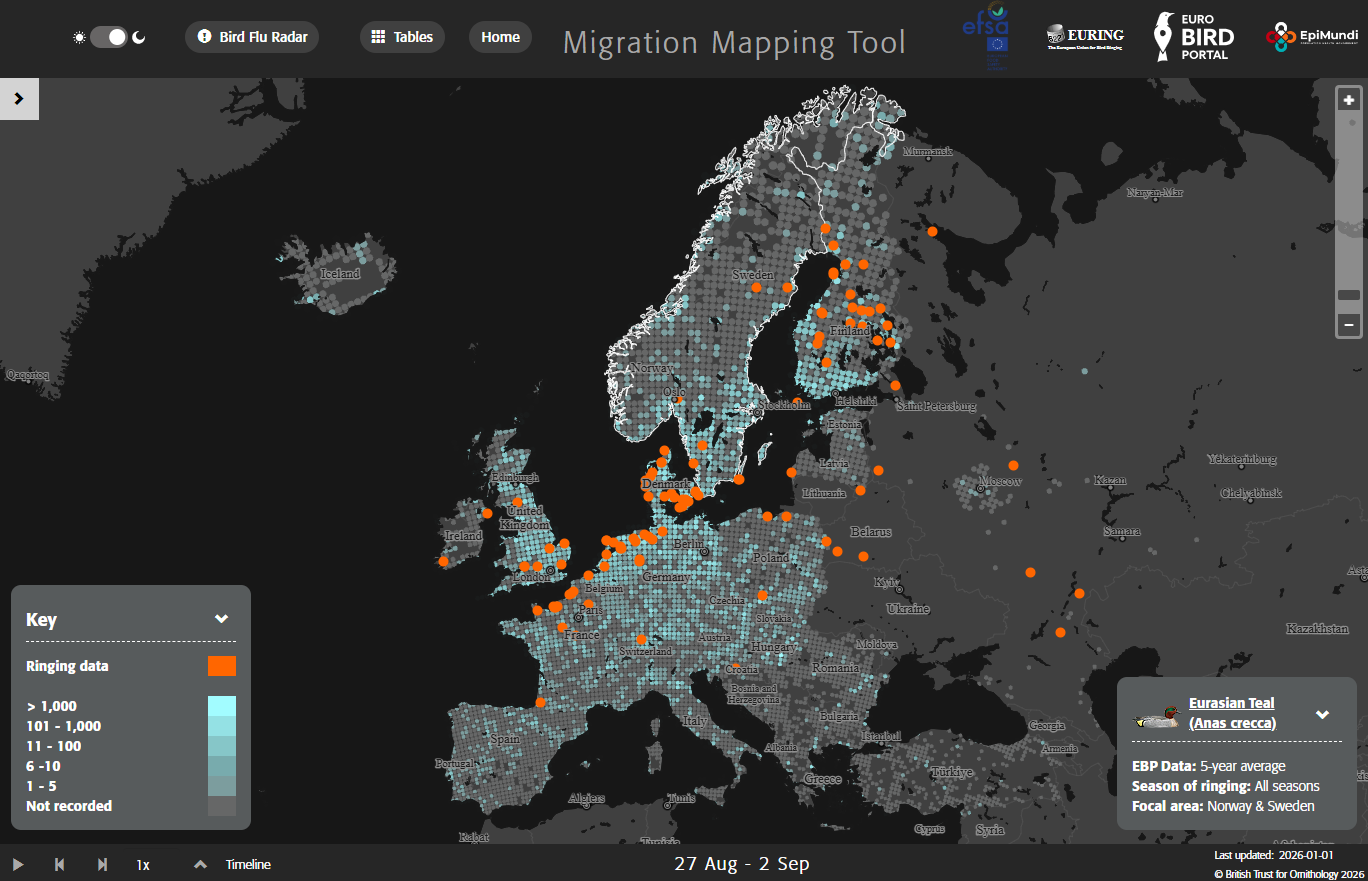
The Migration Mapping Tool

This online tool was launched in 2022 and provides information of the migratory connectivity of 50 bird species in Europe, primarily to inform management of Avian Influenza outbreaks and the risks of other disease transmission by birds.

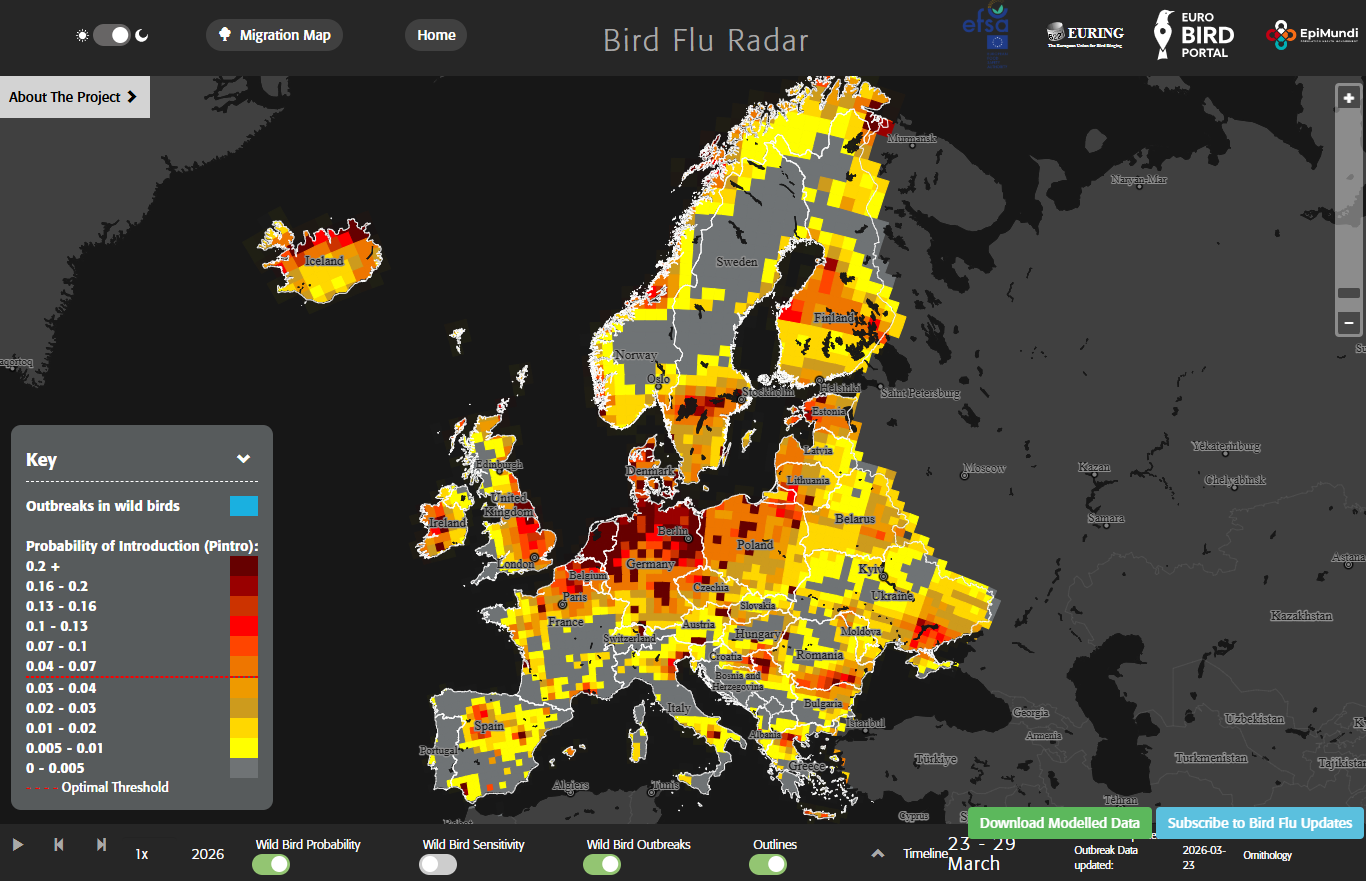
Bird Flu Radar

This Early Warning System, launched in 2023, combines the data on bird distributions and movements shown in the Migration Mapping Tool with that of Highly Pathogenic Avian Influenza (HPAI) outbreaks to estimate the probability of occurrence of new outbreaks across Europe.

Acknowledgements

The EBP is possible thanks to the more than 100,000 volunteer birdwatchers that submit their observations to the on-line bird recording portals run by the EBP partners. Without their continuous contribution in time, effort and expertise the EBP project would be unfeasible. Our big thanks to all of them.

Many thanks also to all the representatives of the different EBP partners for their continuous work at the local level and long-term engagement with the project: Zydjon Vorpsi, Erald Xeka (Albania), Clara Pladevall (Andorra), Norbert Teufelbauer (Austria), Jean-Yves Paquet, Kristijn Swinnen (Belgium), Nermina Sarajlić (Bosnia & Herzegovina), Nicky Petkov (Bulgaria), Iva Mihalić (Croatia), Zdeněk Vermouzek (Czech Republic), Timme Nyegaard (Denmark), Andres Kalamees (Estonia), Peter Uppstu (Finland), Philippe Jourde (France), Christopher König (Germany), Danae Portolou (Greece), Nagy Károly (Hungary), Snæþór Aðalsteinsson (Iceland), Brian Caffrey (Ireland), Yotam Lenard (Israel), Enrico Caprio, Roberto Lardelli (Italy), Qenan Maxhuni (Kosovo), Ilze Priedniece (Latvia), Marius Karlonas (Lithuania), Patric Lorgé (Luxembourg), Nicholas Galea (Malta), Silvia Ursul (Moldova), Bojan Zeković (Montenegro), Ruud Foppen (Netherlands), Danka Uzunova (North Macedonia), Frode Falkenberg (Norway), Tomasz Chodkiewicz (Poland), Joaquim Teodósio, Carlos Godinho (Portugal), Zoltán D. Szabó, Cristi Domsa (Romania), Mikhail Kalyakin (Russia), Vukašin Kartalović (Serbia), Jozef Ridzoň (Slovakia), Tomaž Mihelič (Slovenia), Blas Molina, Juan Arizaga (Spain), Johan Nilsson (Sweden), Samuel Wechsler (Swizerland), Itri Levent Erkol (Turkey) and Tom Jordan (UK). Our thanks also to Gaëtan Delaloye, Noémie Delaloye (Ornitho), Ian Davies, Wesley M. Hochachka (eBird) and Dylan Verheul (Observation.org), for their commitment with both the project and the EBP partners using their respective online platforms.

The EBP data flow works thanks to the efforts of many skilled IT professionals working behind the scenes across the different online portals that contribute to the EBP. Our big thanks to all of them: Johan Nilsson (Artportalen), Dana Music (Artsobservasjoner), Alexander Kürthy (Aves-Symfónia), Zbyněk Janoška (Birds.cz), Adam Faiers, Mark Hammond, Justin Walker (BirdTrack), Sandis Krutovs (Dabasdati), Timme Nyegaard (DOFbasen), Jasdev Imani (eBird), Nicholas Galea (Malta), Tibor Gincsai, Nagy Károly (MAP), Alex Kerkum, Dylan Verheul (Observation.org), Bóné Gábor (OpenBirdMaps), Cristi Domsa (Ornitodata), Rūta Kembrytė (ornitologija.lt), Gaëtan Delaloye, Jennifer Meinen (Orntiho), Kessy Abarenkov (PlutoF), Tomaž Mihelič (ptice.si), Aleksej Anovski, Metodija Velevski (ptici.mk), Iliya Ukolow (Rus.birds), Georgi Popgeorgiev (SmartBirds), Antti J. Lind (Tiira) and Gerard Troost (Trektellen/SOVON).

Many thanks also to all the past and current members of the EBP Executive Committee for their dedication to the project (Sylvain Antoniazza (SOI), Stephen Baillie (BTO), Jennifer Border (BTO), Ruud Foppen (SOVON), Carlos Godinho (LabOr), Nagy Károly (MME), Jean-Yves Paquet (Natagora), Vukašin Kartalović (BPSSS), Peter Uppstu (BirdLIfe Finland) and Samuel Wechsler (SOI)), and to Hans Schmid (SOI), in particular, for promoting the creation of the working group that ended up becoming the EBP project shortly afterwards.

We would like to extend our thanks also to the top-notch location intelligence and data visualization platform, CARTO, for allowing us to transform the EBP data into great animated maps, and to Toni Llobet and Martí Franch for the drawings that illustrate the bird species shown in the viewer.

The EBP has also been possible thanks to the financial support provided by several organizations.

In that regard, the continuous support offered by the Swiss Ornithological Institute has been vital for the development of the project, particularly during the very first years of operation.

The EBP has also been funded by the European Commission Directorate General for the Environment through two different LIFE projects: the LIFE EBP (2016-2019) and LIFE EBP Reinforcement (2023-2026). The first one co-financed by the Government of Catalonia and the second one by the Swiss Ornithological Institute, Natagora and the EBCC.

Since 2019 we have also been receiving the financial support from EFSA for the work on Avian Influenza developed co-jointly with EURING.

Major funding partners

Contact

Gabriel Gargallo
EBP Project Coordination

ICO - Catalan Ornithological Institute
Nat- Museu de Ciències Naturals de Barcelona
Pl. Leonardo da Vinci 4-5, 08019 Barcelona, Spain
phone: 00 34 93 458 78 93 email: [javascript protected email address]
Samuel Wechsler
Chair of the EBP Executive Committee

Swiss Ornithological Institute
Seerose 1, 6204 Sempach, Switzerland
email: Samuel.Wechsler@vogelwarte.ch