September 10th, 2026
For the first time, the occurrence of all bird species in Europe can be tracked in near-real time
The new version of the EBP viewer has already been open to
the public.
This new version provides free access to hundreds of
animated maps showing the weekly distribution of nearly 600 bird species
updated close to real time. Namely, all those regularly and naturally occurring
within the EU (477), those introduced that have self-supporting breeding
populations (32) and a selection of the more regular vagrant species (58).
Now everyone can check the whereabouts of their favourite
bird with just a few clicks!
The Bee-eater and the Hobby are two of the new species that can be seen in the EBP viewer now
This has been made possible by the extraordinary volume of
data collected by the different online bird recording portals operating in
Europe: 750 million bird records since 2010, of which 76 million in 2026 alone.
All this data is automatically submitted to the EBP central
database on a daily basis, enabling all maps in the viewer to be updated daily
with the most up-to-date information.
This huge biodiversity dataflow, the largest currently
operating in Europe in near-real time, has been completed thanks to support
from EU’s LIFE Programme (LIFE EBP Reinforcement project) and the close
collaboration of a network of 52 ornithological organizations from 41 differentcountries.
The first version of the EBP viewer was launched in 2015,
and four years later (2019) it was redesigned to work in live mode, showing
data up to the previous day. As in previous versions, the current viewer
depicts the week-by-week distributional patterns of bird species using
different types of maps. Moreover, to facilitate direct comparison and to
better glimpse differences in bird occurrence, two animated maps of any type,
species and year can be selected to be shown simultaneously, offering thousands
of different map combinations to choose from.
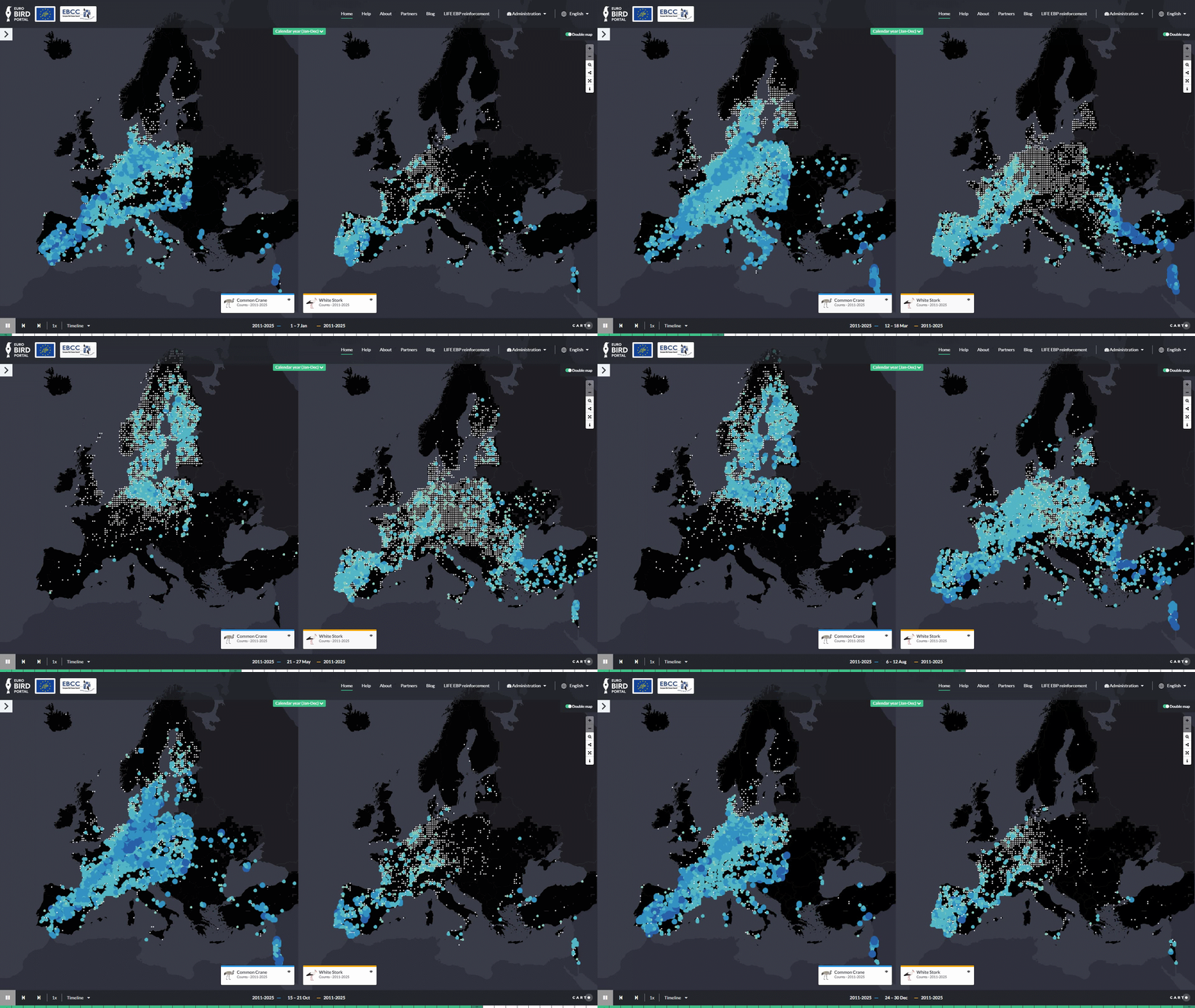
Our warm thanks to the more than 200,000 volunteer
birdwatchers who regularly share their observations with the various online
bird portals. The new EBP viewer is a recognition to their vital role in the
project and showcases how such individual local contributions can be summed up
in favour of bird conservation and outreach at the European scale.
Permanent link
September 10th, 2026
For the first time, the occurrence of all bird species in Europe can be tracked in near-real time
The new version of the EBP viewer has already been open to
the public.
This new version provides free access to hundreds of
animated maps showing the weekly distribution of nearly 600 bird species
updated close to real time. Namely, all those regularly and naturally occurring
within the EU (477), those introduced that have self-supporting breeding
populations (32) and a selection of the more regular vagrant species (58).
Now everyone can check the whereabouts of their favourite
bird with just a few clicks!
The Bee-eater and the Hobby are two of the new species that can be seen in the EBP viewer now
This has been made possible by the extraordinary volume of
data collected by the different online bird recording portals operating in
Europe: 750 million bird records since 2010, of which 76 million in 2026 alone.
All this data is automatically submitted to the EBP central
database on a daily basis, enabling all maps in the viewer to be updated daily
with the most up-to-date information.
This huge biodiversity dataflow, the largest currently
operating in Europe in near-real time, has been completed thanks to support
from EU’s LIFE Programme (LIFE EBP Reinforcement project) and the close
collaboration of a network of 52 ornithological organizations from 41 differentcountries.
The first version of the EBP viewer was launched in 2015,
and four years later (2019) it was redesigned to work in live mode, showing
data up to the previous day. As in previous versions, the current viewer
depicts the week-by-week distributional patterns of bird species using
different types of maps. Moreover, to facilitate direct comparison and to
better glimpse differences in bird occurrence, two animated maps of any type,
species and year can be selected to be shown simultaneously, offering thousands
of different map combinations to choose from.
Our warm thanks to the more than 200,000 volunteer
birdwatchers who regularly share their observations with the various online
bird portals. The new EBP viewer is a recognition to their vital role in the
project and showcases how such individual local contributions can be summed up
in favour of bird conservation and outreach at the European scale.
Permanent link
March 10th, 2026
An overview of complete lists data collection in SE Europe in 2025
One of the aims of the
LIFE EBP Reinforcement project is to increase participation in the collection
of bird observations, especially of complete lists, through the online bird
portals operating in SE Europe. This part of the project includes 13 countries,
seven core ones (Albania, Bosnia and Herzegovina, Kosovo, Moldova, Montenegro,
North Macedonia, and Serbia) and six additional countries (Bulgaria, Croatia,
Greece, Hungary, Romania, and Slovenia).

The first step was to
establish national online bird data collection portals in the seven core
countries, as none existed before the start of the project. This was done
gradually, starting in mid-2023, and nowadays all countries have a functional local
portal or, at least, can collect data through the local mobile apps.
Thanks to these
developments and an ongoing data collection campaign, since the project started
in mid-2023, there has been a positive trend in the collection of complete
lists. The overall number of complete
lists in the core area increased from 563 in 2023 to 1,206 in 2024 and to 3,585
in 2025 (6,4 times the figure of 2023). The rest of the region also shows a positive
trend, though much less marked and stalling in 2025 (39,578 complete lists in
2023, 51,256 in 2024, and 45,565 in 2025). All in all, we reached a total of 49,150
complete lists in 2025 across all 13 countries, 22,4% more than in 2023.
Another good sign
comes from the percentage of records in complete lists, which was highest in
2025, at 69,1% (compared to 62,1% in 2024 and 54,6% in 2023). Similarly, the
number of observers entering data appears to be increasing across the region,
with the highest number recorded in 2025 (3,616 observers; 21,8% more than in
2023).
You can follow the
progress of these efforts on the SEELists wesite, which was established specifically to
showcase the progress of complete list collections and species phenology graphs
across SE Europe.

Although the trend is largely
positive, we still aim to increase the overall numbers in 2026 and engage even
more people in data collection in the region. Given that complete lists are
more valuable than causal records, we encourage everyone to collect them
whenever possible. This is especially true if you find yourself in a region
such as SE Europe, where data collection is still much lower than in other
parts of Europe.
Permanent link
December 5th, 2025
Falling leaves, migrating birds and our 3rd complete list challenge weekend in SE Europe
This autumn, partners from 13 countries in SE Europe (Albania, Bosnia & Herzegovina, Bulgaria, Croatia, Greece, Hungary, Kosovo, North Macedonia, Moldova, Montenegro, Romania, Serbia and Slovenia) organised a simultaneous complete list challenge weekend to boost participation and more standardised data collection in the region. This is a third such weekend challenge in 2025, which coincided with the EuroBirdwatch dates (5-6th October), enabling partners to use the synergies and promote the collection of complete lists along with outings planned for public.
In Albania, two partners organised separate events, with AOS organising a field activity at Divjaka-Karavasta National Park with 20 high school students the day prior to the weekend, which included guided bird observations and stressing the importance of structured data collection. The second partner, PPNEA, postponed the planned event in Fllaka lagoon for the second weekend, due to weather conditions, where 3 volunteers had the chance to collect complete lists and observe some interesting species, such as Whimbrel, Grey Plover and Common Redshank.

